We’ve reached some sort of tipping point. You can watch Apple’s entire 25-minute iPhone Duo keynote presentation, as I did, and walk away not knowing how to use a product with “phone” in the name as a phone.
I assume you take phone calls with it folded, holding the outer screen to your ear like a traditional smartphone. Putting the camera side to your ear makes no sense. But can you take a phone call with it fully unfolded, holding a tablet up to your ear? Keep it open but partially folded like an old clamshell phone? Or if someone calls you when you have it open, do you need to snap it shut then accept the call?
I like keeping up with new tech, not that folding phones are “new” but rather that if Apple finally decided to offer one, it probably means the product has reached a point where the design and manufacturing are reliable enough that they’re not worried about replacing a bunch of units with failed displays after a year or two.
Apple finally bringing a folding phone to market also represents their biggest evolution in phone design since the original iPhone’s release in 2007. And with that, perhaps also an evolution in the marketing. iPhone keynote releases long ago stopped featuring video of people making voice calls, or even background footage or images of someone holding the phone to their ear. We’ve all known for a very long time how it looks to make a phone call on a traditional slab-style smartphone, so not including that footage is forgivable.
How does it look to make a voice call on iPhone Duo, though? The audience does not already know this information at the time of the keynote release. Was it omitted because phone calls are such a boring, standard part of smartphones that they’re not even worth a 5-second clip of someone answering their phone? Was it omitted to standardize the marketing with the traditional iPhone 18 Pro segment? Or is it just meeting the average consumer where they are, what they’re using their devices for?
We get to see a couple quick clips of someone sending a text message, or making a FaceTime call. We get several minutes of footage of people using the iPhone Duo camera with some heavily cherry-picked shots and misleading mention of “optical quality telephoto” which is just rebranded digital zoom, to paper over the fact that this $2,000 device has no telephoto lens and will take significantly worse pictures than an iPhone Pro from several years ago.
There’s a lot more time spent showing footage in the iPhone Duo keynote of people watching videos or playing mobile games on the unfolded tablet-size screen. “Multitasking” to Apple is apparently the ability to have a YouTube video open and playing on the top half of the screen while viewing the live chat or having some other app open on the bottom.
Overall, I’m left feeling that the marketing for smartphones has reached a tipping point. The way most people use their phones, they are barely “communication devices” any longer. Phones are content consumption portals for most people, and the marketing has to reflect that. They barely have to reference how you can use the device to be more productive, and the remaining examples are super silly such as seeing your email inbox list and reading a message simultaneously (like one can do on any desktop email client ever).
The tech-as-productivity-nirvana marketing is lost. Remember when we used to get to hear about how [New Device] would tangibly improve or simplify our lives? And that would provide part of the justification for purchasing it, even if such productivity gains were ultimately never realized after the purchase. In Apple’s keynote we don’t see anyone pull an iPhone Duo out of their pocket to slap on an external keyboard and use their “80% larger than iPhone Pro” display to more effectively write something. We don’t see an artist use the Duo’s Apple Pencil support to make a quick sketch on the go. We don’t see anyone use the iPhone Duo as a useful companion tool to do much of anything aside from “consume content”. But get this, it folds over to display the time on your nightstand!
The coolest potential features of folding phones
I don’t like perpetual negativity/contrarianism and I’m not bandwagoning iPhone Duo hate. I’m not even sure what the public consensus on this device is because I haven’t read any comment threads about it.
There’s a couple of really cool things about folding phones in general, and they’re also noted in the iPhone Duo presentation, but unfortunately they’re briefly tossed on the screen as afterthoughts, overshadowed by surrounding clips of yet-more people watching videos and playing mobile games.
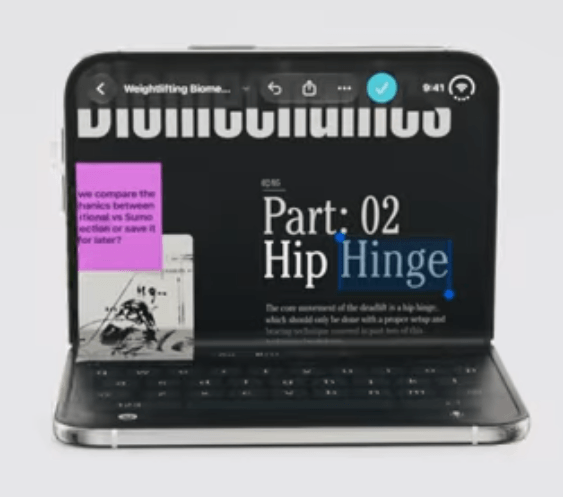
The first potentially cool feature is being able to use your phone as a mini laptop, cyberdeck-esque. This is certainly not an Apple development, since the Samsung Galaxy Z Fold 2 that came out in 2020 had this functionality. This feature also seems less practical on the iPhone Duo than Android folders, since the iPhone folds along the long edge giving you under 4.5" of width on which to fit an entire keyboard. Obviously this isn’t as useful as a real keyboard for typing, but you could probably type much faster on this using four to six fingers than using two on a traditional phone.
Power users will run straight into the wall of this being a mobile OS and not a full desktop OS, which is probably why they didn’t show more footage of the Duo-as-cyberdeck. You’re barely allowed to manage your own files in your iPhone’s local storage (unrooted Android is only a tad better in this regard) and most mobile app variants are so nerfed I always just question why I didn’t drag along my laptop. I’ve tried to use both main flavors of mobile OS paired with an external keyboard as a portable productivity setup and they’re generally exercises in frustration compared to doing the same tasks on a laptop.
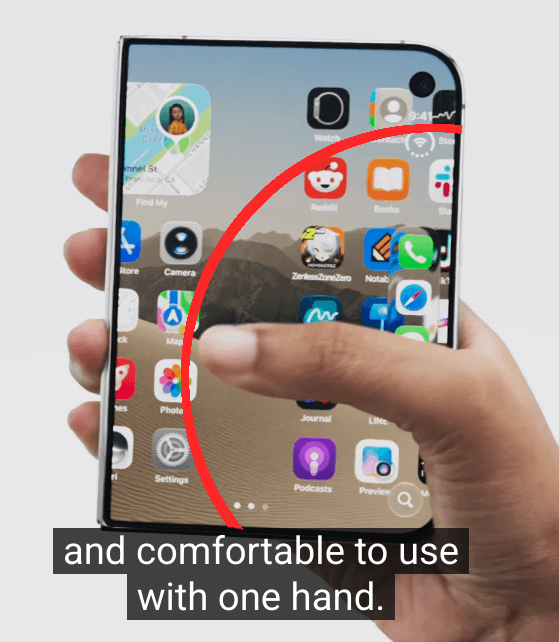
Making the iPhone Duo shorter and wider than a standard phone when folded also leads to this hilarious contradiction of one-handed usability when folded, given that for most people the length of their thumb is already a limiting factor for screen reach on modern huge smartphones:
The second actually cool, interesting thing that iPhone Duo and some other folding phones have is digitizers with stylus support. Being able to open it up to the Duo’s 7.6" display (8" for Samsung Galaxy Z Fold 8 Ultra) and use it as a pocket notebook or pocket sketchbook is actually an enticing feature. This is roughly the same size as those common pocket composition notebooks fully opened, and for people that prefer writing to typing for note taking I could see it being an attractive draw.
Tempering how handy it would be to take handwritten notes on a pocketable tablet with an actual stylus is the price. $2k for the iPhone Duo (plus $79 for the Apple Pencil) or $2,100 for the Z Fold 8 Ultra buys any other iPhone on the market plus a lot of notebooks and some really nice pens. If you really need a portable digital notetaker, you could get Remarkable Paper Pro Move ($449) and pair it with an iPhone Pro for less than the price of the Duo; of course you then have to carry two devices… but is this really that big of a deal? Maybe not trying to do everything on a single device is better for us.
Digital minimalism via physical maximalism
More people than ever use their phone as their primary or only computing device. That doesn’t mean that phones are particularly good at being primary devices, just that they’ve cleared the low bar of most peoples’ technical requirements for a computer, they do a lot of tasks at least to an okay degree, and they’re conveniently pocketable. But they’re also insidious time sinks and the easiest gateway to getting trapped in the attention economy.
This leads to an interesting world where “digital minimalism” now often means owning more, single-purpose physical devices or items that do their one thing better than an all-purpose smartphone, and also allow one to engage in said things in a more focused fashion.
I take my Boox Palma 2 pocket e-reader essentially everywhere I think I might want to read, so I’m usually carrying the equivalent of two phones if I have my iPhone on me as well. If I’m taking my backpack, I have at least an A4 notebook in there and some pens. I made an E-Ink calendar for my fridge that updates with all of my family’s events for the week and displays the daily weather, so I don’t have to check my phone as part of my morning routine. Most of my recent device purchases or electronics projects have been a way to decentralize functions away from my smartphone and reduce reliance on third parties by self-hosting.
New Apple CEO John Ternus referred to Apple’s devices as an “intelligent personal hub” during the keynote. Interestingly I’ve found that as I’ve grown to use my phone less as a “hub” for everything, I’ve become far happier with my digital habits.