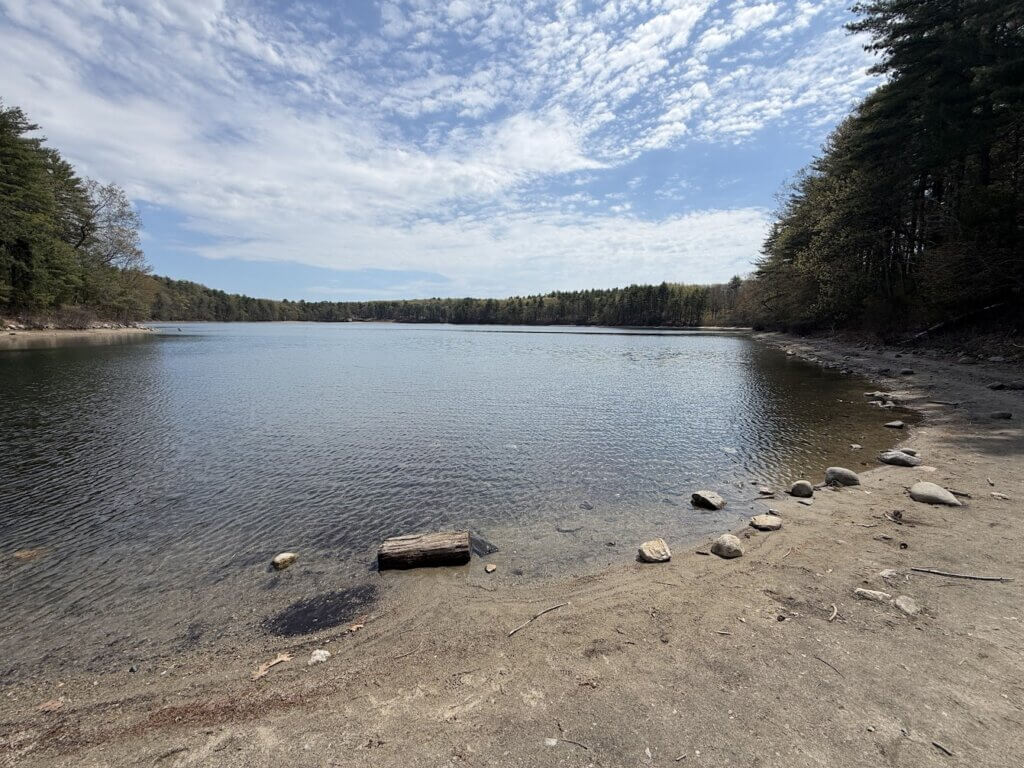
A young woman sets up a blanket to relax on the beach at Walden Pond and pulls out a book. She opens it to the beginning, and takes a picture of the spread pages with her iPhone. She puts the book away and gets absorbed in her phone. For at least the next twenty minutes I was in viewing distance, the book doesn’t re-emerge; perhaps she pulled it out later in the morning, or perhaps it’s sitting in the same beach bag, still unread a week after.
I would have thought this was a skit or exaggerated retelling if I didn’t observe it myself, or if it was the first time. But it’s a scene I’ve seen before, commonly when on a vacation that involves lounging by a beach or a pool. Where the population commonly consists of a handful of people actively reading, a few more people who intended to read, and a whole lot more people on their smartphones desperately fighting over the hotel’s limited internet bandwidth to scroll to the next thing in their feeds.
And what of the photo? Was it a personal keepsake? Sent to a friend or two? Shared widely on social media? I can only speculate. The woman at Walden clearly planned the perfect late morning and early afternoon: a relaxing morning reading a book in the birthplace of American transcendentalism, a promised reprieve of solitude away from the intrusions and demands of modern life, just as Henry David Thoreau sought 181 years ago. Only to have her attention hijacked by the most intrusive and demanding piece of modern technology we’ve invented.
The social currency of being seen as “someone who reads” is easy enough to acquire. A photo of an open book shared on social media; a couple of books on the coffee table that proclaim one’s interesting and worldly tastes; an Amazon Kindle with a dozen or so books on it that is languishing in a junk drawer somewhere, and used its last gasps of charge to print a critical battery alert on the E-Ink display.
The act of being a reader requires more investment. Intent. Focus. Time. Perhaps less of them than many people might think; if you have five minutes you can certainly read an article or a few pages of a book, but too many of us squander those small blocks of time on frivolous and unrewarding traps. Just figure how much five minutes at the top of every waking hour spent “killing time” sums up to in the course of a day (and we all know the average person is checking their smartphone far, far more often than that).
Every passing year I hear more and more people say something like “I need to read more.” There’s really only one solution to that and it starts one page at a time.
I’ve found a pocketable e-reader invaluable for redirecting these small extra blocks of time towards reading a few more pages here and there. This is a growing product market segment led by Chinese manufacturers like Boox, Bigme, and XTEInk. I can’t fit a book or my Kobo e-reader in my pocket, but I can fit another phone-sized device. I find E-Ink screens far more pleasant to read on than LED screens, and the black-and-white, slow refresh rate is not conducive for using the device for anything except reading or maybe typing with an external keyboard.
Of course, reading on a phone, if that’s the only device one has on hand, is certainly better than not reading at all if one has aspirations to read more books. But it probably takes a lot more focus and self-discipline to read on a phone, or setting up a shortcut to enable “Do Not Disturb” every time the reading app is opened. And it’s always incredibly obvious from a distance who is using their phone to read versus scrolling or watching something.
Paul Samuelson, the first American to win the Nobel Prize in economics, pioneered the concept of “revealed preferences” to better measure how individuals’ preferences varied between available choices. Samuelson realized that rather than asking consumers which good they’d prefer to purchase between two choices, better data could be obtained by simply observing what the consumers actually purchased. There was a gap between what consumers wanted their claimed purchases to say about them as a person, versus what they actually ended up buying. The modern behavioral economics interpretation of this theory would say something like, if a person says they want to read a book but their actions show they just used their phone, their revealed preference would be that they actually wanted to spend their time scrolling. This is probably too simplistic when comparing a normal activity to a behavior increasingly driven by addiction, but it’s an interesting piece of the picture.
Data backs up this mismatch between people who claim they want to read and those who do. A joint NPR/Ipsos poll from early 2025 found that “82% of respondents think reading is a useful way to learn about the world, 76% say reading is relaxing and a whopping 98% of respondents with children in their household want their children to ‘develop a love of reading.’” However, only “51% of people read a book in the past month… In comparison, about 80% of people watched streaming services, used social media or watched a short-form video.”[1]
A Literary Hub article by Brittany Allen cites another reading poll from 2025, this one run by YouGov, and summarizes self-reported reading metrics for last year: “Four in ten Americans didn’t read a single book during our last spin around the sun… The median American read two books in 2025. The average reader clocked in with eight. To put it starkly? 19% of American adults did 82% of the country’s reading.”[2]
These numbers are almost certainly overestimates; responses to self-reported polls on behaviors have been observed to follow a social-desirability or aspirational bias. Even in anonymous polls, respondents will almost always inflate the estimated time spent performing a “desirable” activity like reading, and underestimate the time they reported spending on less valuable activities like watching television or scrolling the web.
Smartphones are just one example of the intrusions and demands of modern life, which have only grown more grating and insistent since Thoreau’s time, creeping into Walden Pond. People with nearby books they’re not reading is just one of many modern ironies at Walden.
There’s the constant drone of the immediately adjacent highway, Route 2, occasionally punctuated with the shrill whine of a motorcycle. Immediately approaching the pond from the main parking lot, there’s a large fenced-off area being clear-cut of trees — certainly not very Thoreauvian — to make room for an expanded bath house. Like most other water sources in Middlesex County, my town’s water included, Walden is contaminated with PFAS “forever chemicals” from paper and textile mill waste dumped into streams decades ago. There are frequent signs reminding fishermen not to eat their catch, because the fish themselves now contain over the recommended concentration of PFAS.
Approaching the original site of the cabin, there’s a sign with Thoreau’s famous “I went to the woods because I wished to live deliberately” quote, incredibly likely to be the only sentence from Walden that most adult visitors to the pond have ever read. More importantly perhaps, how many will read Walden after visiting the pond, then return later with a fresh perspective? It’s a rite of passage for southern New England schoolchildren, as I once was, to be forced to read some excerpts and chapters from Walden, take a field trip to the pond, and question why they had to read a few chapters from the boring old book anyway. Hopefully it doesn’t sour too many of them on giving it another fair shot at a read once they’re an adult.
Yet there are still occasional hints of Walden’s former state. The MBTA trains run by a few times an hour on the tracks directly next to the western side of the pond; they’re diesel-electric trains now instead of steam locomotives, but it’s the exact same Fitchburg Railroad line built a few years before Thoreau went to live at Walden. For him it was a symbol of rapid industrialization, the unending spread of commerce, and an auditory invasion into the natural sounds of his woods that he recorded in the Sounds chapter. In the modern day, it’s one of the few almost completely preserved experiences about Walden as Thoreau would have lived it.
Despite all of these encroachments on the serenity of the place, despite that there are multiple other quieter, less busy ponds within an hour’s drive, let alone several still within Concord itself, Walden’s allure remains. If you head to the southwestern side of Walden Pond, roughly as far as one can get from all nearby roadways, you might just be able to experience it if you’re patient. The highway will quiet enough for the wind to carry the sound away, there will be no private jets or prop planes flying overhead, and for a minute or two here and there you can experience Walden Pond as Thoreau did. That is, if you’re not too busy looking at your phone.
Limbong, Andrew. “Most Americans Want to Read More Books. We Just Don’t.” NPR, NPR, 7 Apr. 2025, www.npr.org/2025/04/07/nx-s1-5333652/books-reading-poll. ↩︎
Allen, Brittany. “In 2025, Most Americans Read Fewer than Four Books.” Literary Hub, 5 Jan. 2026, www.lithub.com/in-2025-most-americans-read-fewer-than-four-books/. ↩︎
Can’t believe she’s missing out on the ant battle chapter